Guide
AI-assisted quotes: workflow, data and human approval
Plan AI-assisted quotation preparation with reliable price sources, human approvals and a worked business case. Includes a practical starting checklist.
AI-assisted editorial article by EVORI. Sources are listed below; worked examples are labelled as assumptions.
AI can support quotation preparation by extracting enquiries from emails and documents and preparing a draft. Your team reviews the scope, price and terms before sending it. Start with one frequent quotation type, an approved price list and an accountable approver.
You do not need to replace your ERP for the first trial. Check whether you can access the required data and return a draft to the existing workflow. The quotation-processing use case describes the business context. This guide covers the practical planning.
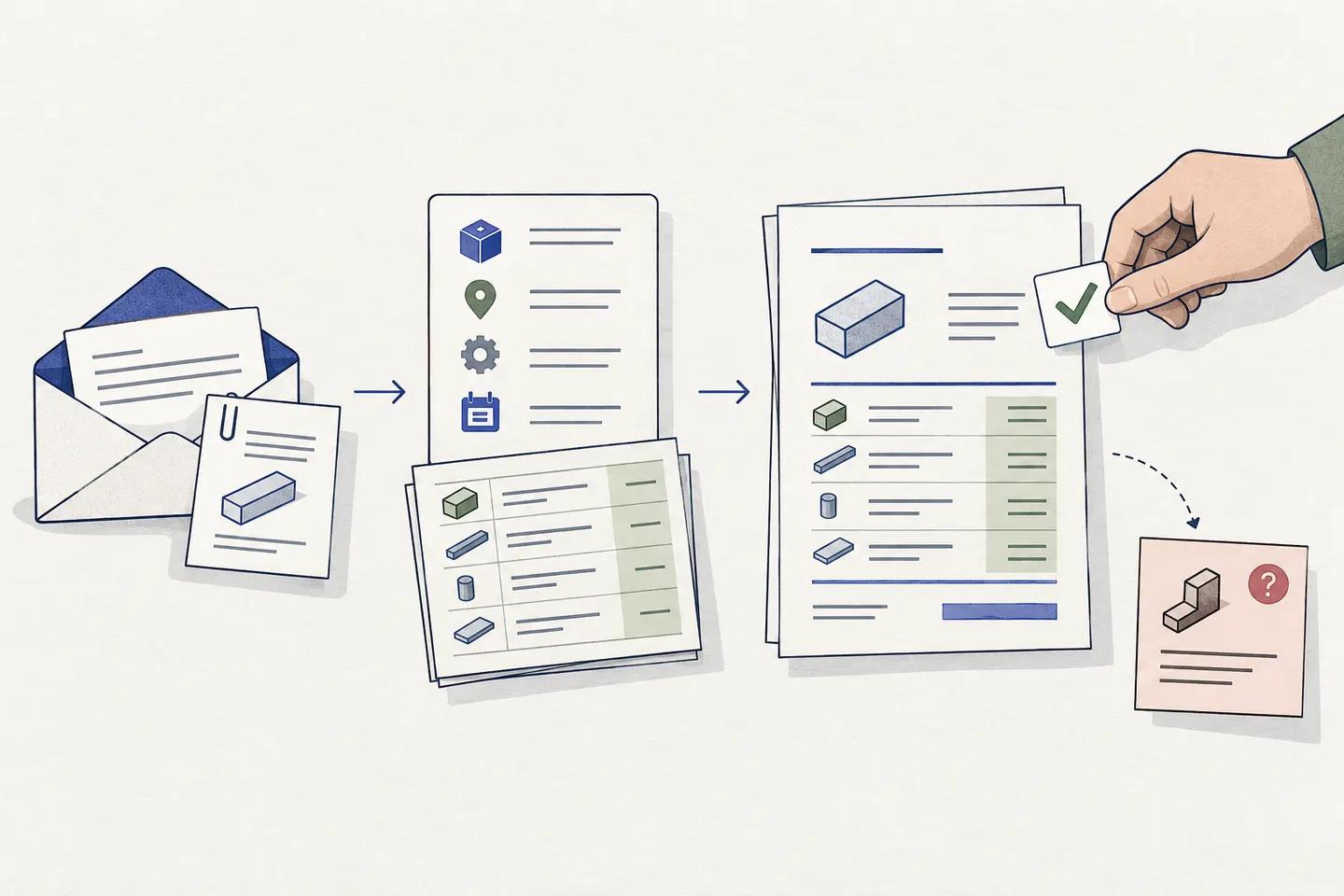
The AI-assisted quotation workflow
| Step | The solution's task | Your team's task |
|---|---|---|
| Capture the enquiry | Extract the requested service, quantity and date | Define the permitted inputs and document types |
| Check the information | Flag missing fields and contradictions | Resolve incomplete or unclear information |
| Match the data | Retrieve products and terms from approved sources | Maintain price lists and matching rules |
| Prepare a draft | Fill your template with the checked information | Review scope and wording |
| Obtain approval | Present the draft, sources and open questions | Approve, correct or reject it |
| Record delivery | Send and file the result after permitted approval | Name an owner and a substitute |
A language model should not invent prices. The solution retrieves numbers from your approved source and records the version used. A missing product or inconsistent detail sends the enquiry back for clarification.
You can implement approval steps with tools such as Power Automate. Microsoft documents document and process approvals; its document-automation example separates extraction, a queue and human review. The suitable technology depends on your systems and operating requirements.
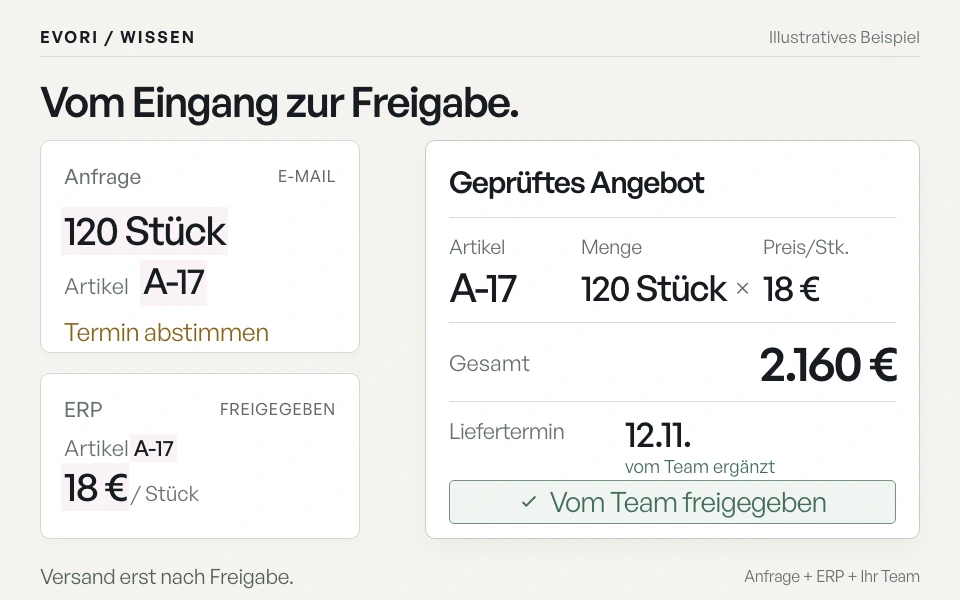
Gather these inputs before starting
Collect representative enquiries and difficult exceptions: missing quantities, contradictory dates, special discounts or outdated product numbers. Remove personal information where it is not needed for testing. Decide who may access any remaining data and where processing may take place.
Add a current price or product list and a quotation template. Specify which discounts sales staff may approve and when another person must decide. Any automated request to a customer also needs an approved template and explicit limits.
If you cannot explain these rules today, settle them before implementation. Faster text generation cannot resolve inconsistent pricing.
A worked business case
These figures are illustrative assumptions, not measured customer results or an EVORI quote. The AI-assisted handling time includes review, corrections and exceptions averaged across the month.
| Assumption | Value |
|---|---|
| Eligible enquiries per month | 120 |
| Current handling time | 20 minutes per enquiry |
| Handling with AI and review | 8 minutes per enquiry |
| Internal hourly cost | 55 euros |
| Running cost | 350 euros per month |
| Initial implementation | 12,000 euros |
The calculation releases 24 hours of capacity per month: 120 × (20 − 8) ÷ 60. At 55 euros per hour, this values the time at 1,320 euros. Subtracting 350 euros in running costs leaves an estimated monthly benefit of 970 euros. Simple payback is around 12.4 months: 12,000 ÷ 970.
Released capacity is not automatically a cash saving. Check whether your team can use it for more work, faster responses or other tasks. Measure complete handling time in the pilot and use your own volumes. The AI cost guide discusses further costs.
Test before sending real quotations
Use separate cases for configuration and final testing. Check whether the solution detects missing information, selects the right price version and returns unresolved cases for review. Include duplicate enquiries and unavailable approvers. An attempt to send without approval must fail.
Record the expected result and the actual rework for each case. The AI pilot checklist helps turn those findings into a documented decision.
Your next step
Download the starting checklist. Fill it in for one quotation type. Use the time-cost calculator to establish your baseline.
If data sources, interfaces or approvals remain unclear, discuss the workflow with us. EVORI integrates AI workflows into existing systems. An introductory call helps identify the questions to settle before commissioning work.
Frequently asked questions
Can AI create sales quotations automatically?
AI can extract information from enquiries and prepare a quotation draft. Prices, products and terms should come from approved data sources. An accountable person reviews the draft before it is sent.
Which data does AI-assisted quotation preparation need?
A bounded starting point needs representative enquiries, a current price or product list, a quotation template and explicit approval rules. Also check whether the relevant systems provide the required access and interfaces.
Sources
Further reading
Apply this approach to your process?
Whether this is your first AI solution or an existing pilot, we clarify the open questions and the right next step. Any additional analysis is commissioned separately only if needed.